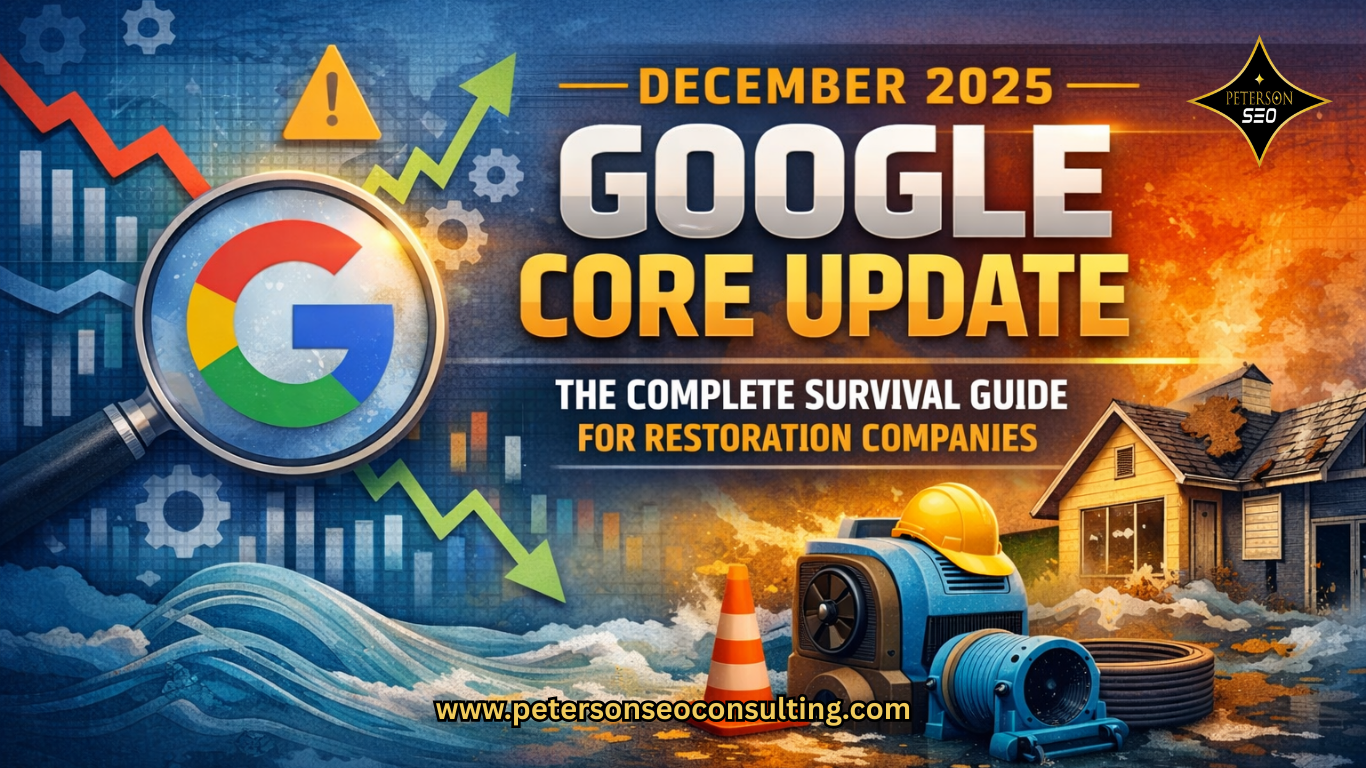
December 2025 Google Core Update: The Complete Survival Guide for Restoration Companies
January 6, 2026 | Peterson SEO | Chico, CA | Albuquerque, NM | USA
The Volatility Is Over, But the Impact Remains
If your rankings felt like a roller coaster in December, you were not imagining it. A lot of restoration owners saw strange shifts where one week the phone lines were steady, and the next week the Map Pack and organic results looked completely different. Some pages jumped up to the top spots, others slipped into obscurity, and many of you changed absolutely nothing on your website. That is the most frustrating part because it feels personal, but it is actually a systemic reordering of what Google believes is best for searchers right now. If you run emergency services, those shifts hit harder because customers make split-second decisions and usually call the first trustworthy option they see.
Here is the reality most contractors need to hear about this specific volatility now that the dust has settled. A core update is not a penalty against your business, and it is not Google targeting the restoration industry specifically. It is Google adjusting how it judges content to determine which results feel most helpful in the moment. During the December 2025 Core Update, the gap widened between pages that feel like real businesses with proof and specificity versus pages that feel like generic templates. The winners look specific, proven, and easy to act on, while the losers often look vague or repetitive. The good news is that you can respond with a clear plan instead of guessing if you understand what actually happened.
The Short Answer: What Happened in the December 2025 Core Update?
The December 2025 Google Core Update was a broad ranking systems update that officially rolled out from December 11, 2025, to December 29, 2025. It took about 18 days to complete according to the official Google Search Status Dashboard, meaning we are now over a week past the finish line. During this window, Google’s systems re-evaluated which pages best matched user intent, causing rankings to fluctuate even for sites that remained static. Google described this as a regular update designed to better surface relevant, satisfying content for searchers across all industries (Search Engine Land). For restoration companies, the primary risk factors during this update were thin service pages or vague marketing copy that failed to demonstrate local experience.
The most critical takeaway for contractors is that this update specifically targeted the "quality" and "helpfulness" of your pages. If your website relies on duplicate content just switching out location info, Google’s systems likely devalued those pages because they do not offer unique value to the user. The smartest response is to use the official rollout dates to identify specifically which pages lost visibility and compare them to the competitors who gained rankings. You need to improve your content’s clarity and "satisfaction score" rather than chasing technical SEO tricks that no longer work (Google for Developers). By focusing on better answers and stronger local proof, you can often regain the positions you lost during the volatility.
The Hard Facts: Timeline and Details
To fix your traffic, you need to look at the right data and ignore the noise. Here are the critical dates you need to reference when analyzing your analytics:
- Official Name: December 2025 Core Update.
- Start Date: December 11, 2025, at 9:25 AM Pacific time.
- End Date: December 29, 2025, at 11:00 AM Pacific time.
- Total Duration: Approximately 18 days of volatility.
- Why This Matters: This timeline gives you a specific window to analyze your performance in Google Search Console. If your traffic dropped on December 23, it is likely part of this rollout, but if it dropped in November, you are dealing with a different issue.
Google explicitly recommends confirming the rollout is finished before drawing conclusions or making panic edits. Stop guessing and start analyzing the window where the movement actually happened so you can see which pages were affected. Understanding these dates prevents you from blaming a holiday lull or a normal weekend dip on the algorithm. It allows you to isolate the variable of the core update so you can make data-driven decisions. Once you know the dates, you can look at which specific keywords and pages lost impressions. This level of detail is the only way to build a recovery plan that actually moves the needle.
Why Restoration Sites Felt This Update Harder
Emergency searches have a different emotional temperature than searches for other local services. People do not browse ten options for water damage cleanup at midnight like they might for a landscaper. They want clarity, proof, and next steps in plain language immediately. Because of this "Urgent Intent," Google’s re-ranking can be extremely volatile for contractors who do not meet that need instantly. Top results are worth thousands in revenue, so even small shifts in the algorithm lead to massive swings in call volume for your business.
There is also a specific issue that plagues the restoration industry and hurts you during updates like this. Many contractors build location pages by cloning the same template and just swapping the city names. When Google re-weighs quality, these thin pages that offer no distinct local value often lose ground to competitors. The pages that won in December were the ones that answered local questions with local reality. These winning pages included typical causes in that region, actual response times, specific neighborhood coverage, and clear process explanations. If your site feels like a cookie-cutter template, Google is finding it easier and easier to rank someone else above you.
Check out one of our recent articles to learn more about Water Damage Website Design That Brings in More Leads.
Why Local Context Matters More Now
We see a common pattern with restoration websites across the United States when we analyze search behavior. A homeowner searches at night after a supply line bursts, a washer overflows, or a storm causes a leak. They are not in a research mood because they are in a panic and need immediate help. They want a company that feels close, credible, and ready right now. They skim the first few results, look for signs of trust, and call the one that seems like the safest bet. In local search behavior, speed is currency, and Google knows this better than anyone.
When a core update reshuffles results, the sites that communicate that trust faster usually keep the calls. Think about how people choose a contractor when they are stressed and staring at standing water. They ignore long blocks of generic text that say "we are the premier provider" because it adds no value. They look for photos of real jobs, clear answers on insurance documentation, and reviews that prove you are legitimate. Research consistently shows that consumers rely heavily on Google to validate local businesses via reviews before they ever fill out a form (BrightLocal). When Google’s ranking systems re-weigh quality, these trust cues become the deciding factor for who ranks first.
Practical Fixes: How to Recover Rankings
If you lost ground, do not burn your website down or start deleting pages randomly. Focus on these three strategic areas to rebuild authority:
- Upgrade Service Pages for Emergency Intent: Make your main service pages the absolute best answer for someone in a crisis by explaining exactly what you do in the first hour. Briefly detail the equipment used and what the homeowner should do before you arrive to minimize damage. Explain how you handle documentation without making illegal promises about coverage, which builds trust without overpromising. This separates you from the lead-gen sites that use vague language.
- Prioritize Your Homepage as a Money Page: Your homepage is often the most authoritative page on your site and ties all other pages together. Ensure it clearly states your primary service areas, features strong "hero" imagery of your team, and links logically to your specific service pages. If your homepage is vague or cluttered with generic stock photos, it dilutes the power of the entire website and fails to pass authority to your service pages.
- Build Unfakeable Experience Signals: Competitors can copy your text, but they cannot copy your reality or your actual work history. Ditch the stock photos of blue gloves and show your trucks, your dehumidifiers, and your actual team members. Add short summaries of real jobs you have handled in the specific city you are targeting to prove you work there. Clearly list certifications and years in business to establish authority immediately.
- Make Location Pages Earn Their Existence: If you serve a specific city, prove it with unique content rather than duplicate templates. Discuss common property types in that market, such as basements versus slab foundations. Mention seasonal risks like frozen pipes in winter versus humidity in summer. Ensure the page is not a duplicate of every other city page on your site. This is the number one reason we see restoration sites lose traffic during core updates.
3 Common Mistakes to Avoid During Recovery
When traffic drops, the instinct is to "do something" immediately, but the wrong moves can make the situation worse. Here are the three most common mistakes we see contractors make after a core update:
1. Panic Editing and Deleting Pages
In an effort to fix "thin content," some site owners start mass-deleting blog posts or older service pages. This is dangerous because even imperfect pages might be passing authority to your important pages through internal links. Deleting them abruptly can destabilize your site structure and cause further drops. Instead of deleting, focus on improving or consolidating. If you have three weak blog posts about mold, combine them into one strong, comprehensive guide.
2. Over-Optimizing with AI Content
It is tempting to use AI tools to generate hundreds of new paragraphs to "bulk up" your pages. While AI is useful for outlines, pasting raw AI text onto your site is risky during a core update recovery. Google wants content that demonstrates "Experience" and "Expertise" (part of E-E-A-T). AI cannot share a personal story about a difficult flood cleanup in your specific town. If you use AI, you must heavily edit it to include your unique brand voice, local details, and real-world examples.
3. Ignoring Technical Site Speed
Core updates often coincide with adjustments to how Google evaluates Page Experience. If your site is slow to load on mobile devices, no amount of text changes will fully fix your rankings. Homeowners in an emergency are almost always searching on their phones. If your site takes 5 seconds to load because of uncompressed images or bad coding, they will bounce back to Google and choose a competitor. Ensure your technical foundation is solid so your content has a fair chance to rank.
FAQs About the December 2025 Core Update for Contractors
Is the December 2025 Core Update a penalty if my rankings dropped?
No, a rankings drop during a core update is not automatically a penalty against your website. A core update is a broad adjustment to how Google ranks content based on relevance and satisfaction. If you were not hit with a Manual Action notification in your Search Console, your site is likely just being out-ranked by pages Google currently views as more helpful. The fix is to improve your content so that it answers user questions better than the competition. You should not file a reconsideration request because there is no manual penalty to lift. Instead, you must audit your pages to see where you lack depth or proof compared to the new top results. A penalty usually comes with a specific message from Google about a guideline violation, whereas a core update drop is simply a shift in how the algorithm values your current content compared to others.
How long should I wait before making changes?
Now that the rollout officially ended on December 29, 2025, and it is already January 6, 2026, you should begin your analysis immediately. Google advises waiting until the rollout is complete to avoid reacting to temporary volatility that naturally happens during the update (Google for Developers). Now is the time to audit your winners and losers because the dust has settled. You want to look at the data from the last week to see where your rankings have stabilized. Making changes during the rollout can often lead to false positives where you think you fixed something that was just fluctuating naturally. Since we are well past the end date, you can confidently start implementing your content improvements today. The goal is to act on data, not emotion, and that data is finally stable enough to read clearly.
Why did my city pages drop if my services did not change?
Google is not just ranking your business entity, it is ranking your individual pages based on their specific merit. If your city pages are too similar because they are duplicate content just switching out location info, they may have been devalued during the quality re-evaluation. To recover, you must add unique, locally relevant value to each specific location page you want to rank. This means adding specific details about that city, such as local landmarks, specific water issues common to that area, or reviews from customers in that town. If every page looks the same, Google has no reason to index and rank all of them highly. This concept is often called "doorway pages," and algorithms are getting much better at spotting them. You need to make sure every page serves a unique purpose for a unique user.
What should a restoration company change first to recover rankings?
Start with your "money pages," which include your Homepage, your core service pages (Water, Fire, Mold), and your primary city location page. Improve the clarity of these pages, add proof of work such as real photos and reviews, and ensure the contact methods are obvious. Fix the pages that drive revenue before worrying about blog posts or secondary content that gets less traffic. These pages are where the conversions happen, so they need to be the most helpful resources on your site. By focusing your efforts here, you will see the biggest impact on your bottom line. Once these core pages are stable, you can move on to optimizing your supporting content. Remember that the goal is not just traffic, but qualified leads, and those leads usually land on your main service pages first.
Did the December 2025 Core Update affect local results and Google Business Profiles?
While this was a "Web" core update, organic rankings and Map rankings are deeply connected in Google's ecosystem. If your website loses authority or relevance signals, it can weaken your overall entity strength, potentially causing you to slip in the Map Pack as well. Google looks at your website to verify the information on your Google Business Profile. If your website content is thin or unhelpful, it provides less support for your local listing. Therefore, strengthening your website content often helps improve your local map visibility. You should treat your website and your Google Business Profile as two parts of the same reputation system. When one part of your digital presence improves, it often lifts the other part with it, creating a stronger overall signal to the search engine.
Did using AI content cause my site to drop in December?
Using AI content in itself is not against Google's guidelines, but publishing lazy AI content is a major risk factor. If you used AI to mass-produce blog posts or service pages without reviewing them for accuracy or adding your own unique insights, Google may have flagged those pages as "unhelpful." The December update placed a heavy emphasis on "satisfying" content. Generic AI text often fails to satisfy a user because it repeats well-known facts without offering specific solutions or local context. If you suspect this is the issue, review your AI-generated pages and inject them with real examples, local data, and your professional opinion to make them unique. The best content usually comes from a mix of human expertise and digital tools, not one or the other in isolation.
Need Clarity on Your Rankings?
If you are a restoration company or contractor and you are not sure what the December 2025 Core Update did to your site, we can help you find out. While we cannot see your internal data without access, we can run a comprehensive external audit of your current rankings, competitor movements, and visible content gaps to show you exactly where you stand. You will get practical recommendations that match how homeowners actually search in emergency situations. You will also get a plan that focuses on content quality, proof, and local relevance instead of guessing.
If you are ready to dig deeper, give Peterson SEO a call at 530-296-6990 or request a free website audit. Once we partner with you, we can look directly at your analytics to tell you what is hurting you, what is helping you, and what to fix in the right order. Our goal is to help you protect your rankings and win more qualified calls through better restoration SEO. You do not need to overreact to core updates, but you do need to respond like a pro. That is what we do every day for contractors who want steady growth, not temporary spikes.
AUTHOR
Jessica is the CEO of Peterson SEO which specializes in restoration and contractor marketing. She is a serial entrepreneur that has not only owned and managed her own businesses and remodeling company, but also helps contractors scale their businesses to new levels. Learn more about Jessica & Peterson SEO.
Request Your FREE Consultation.