





Let me be straight with you. SEO is the foundation of long term restoration marketing success. It builds sustainable, cost effective lead generation that compounds over time. But SEO takes months to show results. Three to six months minimum in most markets. If you are a restoration company that needs leads this month, not next quarter, you cannot just sit around waiting for organic rankings to improve while your schedule has gaps and your phones stay quiet.
That is exactly where restoration PPC fits into a smart marketing strategy. Pay per click advertising puts your company at the top of search results immediately while your SEO foundation builds in the background. Someone searches "emergency water damage restoration" at 2 AM, your ad shows up first, they call, you get the job. Meanwhile, your organic presence is slowly climbing. After six months when your SEO is generating consistent leads, you can reduce ad spend or shift budget to other priorities. Think of restoration PPC as the bridge that gets you from startup to sustainable organic lead flow, not as a replacement for building real search authority.
At Peterson SEO, we build
restoration Google Ads campaigns and Local Service Ads specifically for water damage, fire damage, and mold companies that need immediate lead generation while their long term marketing assets mature. We are not here to convince you that ads are better than SEO. They are not. They are faster. They give you control. And they keep your crews busy while the real marketing foundation gets built. That is the role
PPC for restoration companies
should play in your overall strategy.


When Restoration Companies Actually Need PPC

You expanded into new service areas or added new services. Maybe you just started offering fire damage restoration or opened in a neighboring county. Your existing SEO has not caught up to your new offerings yet. Paid ads let you test demand and generate leads in new areas immediately while you build out the organic infrastructure. This is especially useful when you want to validate whether a new service or location is worth the long term SEO investment before fully committing.
Your market is extremely competitive with established players. In some cities, the top organic spots are locked down by companies who have been investing in SEO for years. Breaking into those rankings takes time and sustained effort. PPC for restoration companies lets you compete for visibility immediately, even against competitors with stronger organic presence. You are not replacing your SEO strategy. You are buying time and market share while your organic authority builds to competitive levels.
You have predictable seasonal demand patterns. Maybe water damage jobs spike during winter pipe burst season or storm damage calls increase during specific months. Rather than keeping your ad spend constant year round, you can increase budget during high demand periods to maximize revenue capture, then reduce spend during slow months when organic traffic can carry more of the load. This flexibility makes restoration PPC cost efficient for companies dealing with seasonal fluctuations.
You need measurable, controllable lead generation. Referrals are valuable until they dry up. SEO is powerful but takes time and the results can fluctuate month to month. Paid ads give you a lever you can actually control right now. Need more leads next week? Increase budget. Booked solid for two weeks? Pause campaigns temporarily. Want to focus on specific service types? Adjust targeting immediately. This control is why many successful restoration companies run ads even after their organic presence is strong. It is about having options and stability, not depending entirely on a single lead source.
Ready to build immediate lead flow while your SEO grows?
Contact us now
Why Landing Pages Make or Break Your Ad Performance
Here is something most restoration companies get completely wrong about restoration PPC. They spend thousands building perfect ad campaigns with tight targeting, compelling copy, and strategic bidding. Then they send all that expensive traffic to their homepage or generic service page. And they wonder why their conversion rates are terrible and their cost per lead is sky high. The problem is not the ads. The problem is where those ads are sending people.
Dedicated landing pages are not optional for successful restoration Google Ads. They are absolutely critical. A proper landing page is a focused, conversion optimized page built specifically for one service and one audience with one clear action you want them to take. No navigation menu pulling attention away. No links to other pages creating rabbit holes where visitors get lost. No generic content trying to serve multiple audiences. Just laser focused messaging that matches the ad exactly, speaks directly to the visitor's specific problem, and makes calling you the obvious next step.
The difference in conversion rates is dramatic. We typically see homepage traffic from ads convert at maybe 2 to 4%. Proper landing pages convert at 8 to 15%, sometimes higher for emergency services. That means for the same ad spend, you get two to four times more leads just by sending traffic to the right place. If you are spending $3,000 per month on ads, the difference between a 3% conversion rate and a 10% conversion rate is an extra 20 to 30 leads per month. That is the impact proper landing pages have on
restoration PPCperformance.
What Makes a High Converting Restoration Landing Page
A conversion focused landing page for restoration advertising follows specific structural principles that maximize the chance someone picks up the phone and calls. Here is what actually works based on testing across hundreds of restoration campaigns. The headline must match the ad promise exactly. If your ad says "Emergency Water Damage Restoration, 60 Minute Response," your landing page headline better say the exact same thing. Any disconnect between ad and landing page creates doubt and kills conversion. The visitor needs to feel like they landed in exactly the right place for their exact problem.
The phone number needs to be massive, prominent, and clickable on mobile. We are talking big, bold, impossible to miss. It should appear at the very top of the page, ideally multiple times as you scroll, and definitely at the bottom. For emergency restoration services, most people just want to call immediately. Make that as easy as possible. The phone number is your primary call to action, not a contact form buried halfway down the page.
Trust signals go right at the top where everyone sees them immediately. IICRC certification badge. Years in business. Insurance accepted. BBB accreditation. Review stars and count. These elements build instant credibility with a stressed property owner trying to decide if you are legitimate. They need to see these trust indicators within seconds of landing on the page, not after scrolling through three paragraphs of text they will not read anyway.
The content needs to be scannable and focused on benefits, not features. Property owners do not care about your equipment specs. They care about getting their property fixed fast, dealing with insurance easily, and knowing the job will be done right. Use short paragraphs, bullet points for key information, and clear benefit driven language. Answer the immediate questions running through their head. How fast can you get here? Do you work with insurance? Are you certified? What happens next if I call?
Before and after photos provide visual proof you actually do this work successfully. Show real projects from your company, not stock photos. Property owners can tell the difference, and authentic project photos build trust while stock images feel fake. If you handle water damage, show flooded rooms and the restored results. Fire damage, show burned structures and the cleanup. Mold, show visible growth and the clean remediation. This visual evidence reassures them you know what you are doing.
The form, if you include one, should be absolutely minimal. Name, phone, brief description of the problem. That is it. Every additional field you add drops conversion rates because people in crisis mode do not want to fill out long forms. They want help now. For emergency services, most conversions should be phone calls anyway, not form submissions. The form is there for people who prefer it, but it should not be the primary conversion path.
Call to action buttons need to be specific and action oriented. Not "Submit" or "Learn More." Use "Call Now for Emergency Service" or "Get Help in 60 Minutes" or "Schedule Free Inspection." The CTA should reinforce urgency and the specific benefit of taking action right now. These buttons should appear multiple times on the page, ideally every screen length or two as someone scrolls, making it easy to take action at any point without searching for how to contact you.
Absolutely no navigation menu or footer links to other pages. This is critical. Every link you add is a leak in your conversion funnel. Property owners click away to your about page, your blog, your other services, and they never come back. A landing page has one job, convert visitors to leads. Anything that does not directly support that goal should not be on the page. No navigation. No blog links. No footer menu. Just focused content driving toward one action, calling you or submitting the minimal form.
Want landing pages that actually convert your ad traffic? Let us build them
Landing Page Ads Versus Call Only Ads
There is ongoing debate in restoration PPC about whether to run call only ads that go straight to a phone call or regular ads that send traffic to landing pages. Call only ads seem appealing for emergency services. Click the ad, phone dials automatically, done. No landing page needed. The problem is call only ads limit your reach and often have lower overall conversion rates than you would expect.
Not everyone is ready to call immediately, even in an emergency. Some people want to see your credentials first. Some want to check your reviews. Some want to understand your process or see proof you are legitimate before dialing. Call only ads force an immediate decision, call now or move on to another company. Landing page ads give property owners a chance to build confidence first, then call when they are ready. This actually converts more total visitors because you are not losing everyone who needs that extra reassurance.
Landing pages also work better on desktop and tablet traffic. Call only ads are primarily mobile focused. While most emergency restoration searches do happen on mobile, you still get search traffic from desktop and tablet, especially for less urgent services like mold remediation or scheduled fire restoration. Landing pages convert this traffic effectively. Call only ads basically ignore it. You are leaving leads on the table by not serving all device types properly.
The tracking and optimization capabilities are also significantly better with landing pages. You can see exactly how visitors interact with the page. Where they spend time. What content they read. Which trust signals matter most. Which CTAs get clicked. This data lets you continuously improve performance. Call only ads just show whether someone called or not. You have no insight into why people did not call or what you could improve to convert more traffic.
Our
recommendation for most restoration Google Ads campaigns is to run primarily landing page ads with call extensions, supplemented by some call only ads for the highest urgency keywords. This balanced approach captures people ready to call immediately while also converting those who need to see your credentials and build confidence first. You get the best of both strategies without limiting yourself to just one conversion path.

Our Restoration PPC Services
Our approach to restoration PPC is built around the reality that emergency services require completely different advertising strategies than normal businesses. Property owners searching for restoration help are often in crisis mode. They are stressed, usually searching on mobile, and they will call the first company that looks trustworthy and available. Your campaigns need to account for all of this urgency while still qualifying leads to avoid wasting budget on tire kickers and unqualified calls.
Google Ads Campaign Structure for Restoration
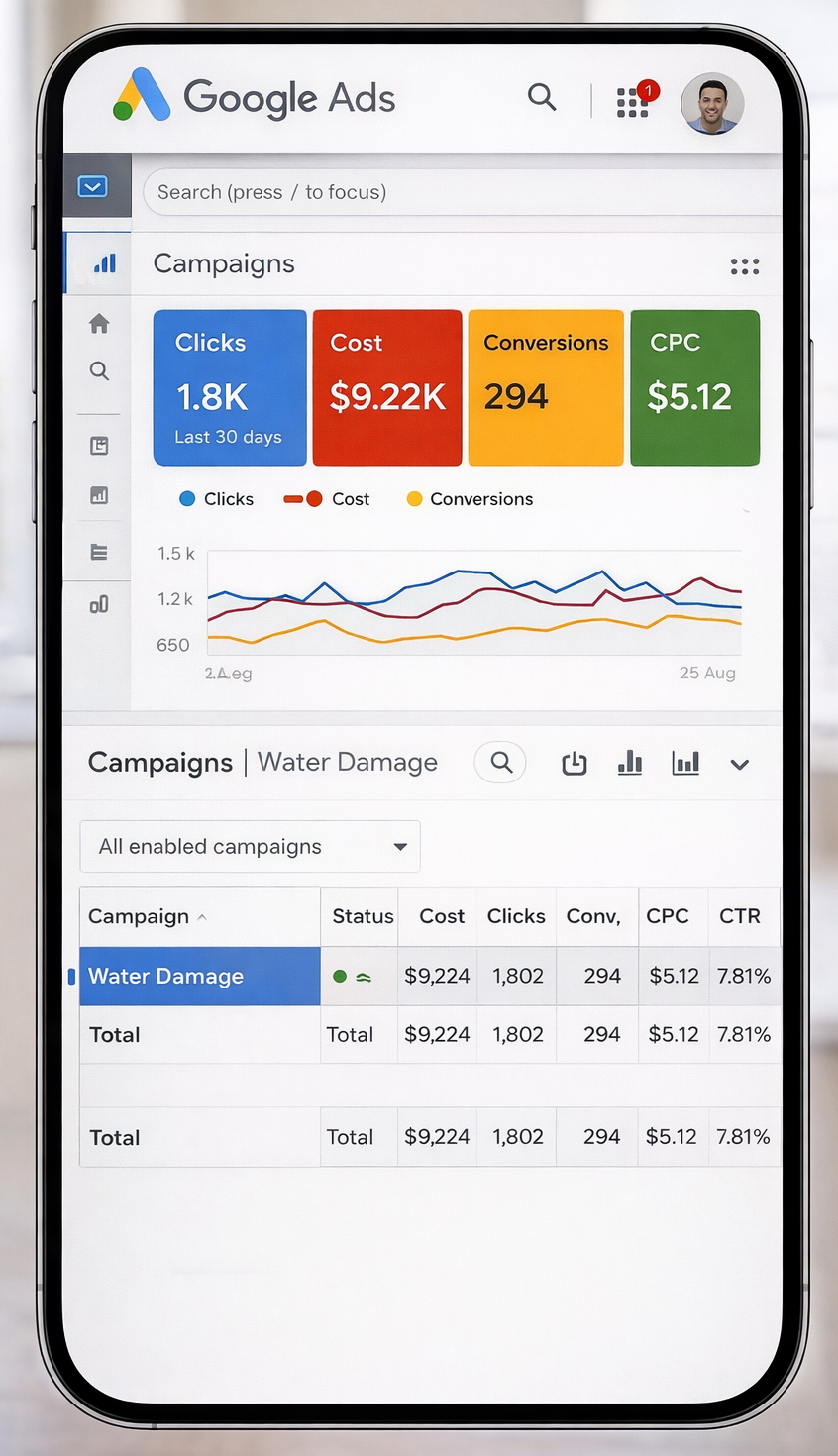
We build restoration Google Ads campaigns in strategic layers, not as one giant bucket of keywords thrown together. Each campaign serves a different purpose and gets managed with different goals and bidding strategies. Emergency campaigns target keywords like "emergency water removal," "24/7 fire restoration," and urgent help searches. These run continuously with higher bids because the intent is crystal clear and the leads are typically your highest value opportunities. Someone using emergency language needs help now and will pay for fast, professional response.
Service specific campaigns separate water damage, fire damage, and mold remediation with messaging tailored to each service type. Water damage ads emphasize speed, 24/7 availability, and immediate response. Fire damage ads mention insurance assistance, documentation support, and understanding of the emotional difficulty. Mold ads focus on certified removal, health safety, and proper containment procedures. This separation lets us optimize ad copy, landing pages, and bidding for each service instead of generic "we do everything" messaging that resonates with nobody.
Brand protection campaigns target your company name and variations. When someone searches your company specifically, often after getting a referral or seeing your truck, you want your ad showing even if you rank organically. This takes up more screen real estate and controls the message they see. In competitive markets, we also carefully test competitor name campaigns to capture comparison shoppers, though this requires nuance to avoid wasting budget on brand loyal searches that will never convert to you.
Geographic targeting gets set precisely to your actual service radius. No point paying for clicks from counties you do not serve or areas where drive time kills your profitability. We can even adjust bids by specific location, spending more in zip codes with better demographics, higher close rates, or less competition. Mobile bid adjustments account for the fact that most emergency restoration searches happen on phones, often from the property itself. Ad scheduling can be adjusted though for true emergency services, 24/7 visibility is usually necessary to capture middle of the night disasters.
Budget management is not set it and forget it. We monitor spend daily, adjust bids based on actual performance, shift budget between campaigns as results dictate, and make sure you are not burning money on keywords that generate clicks but never lead to jobs. Every dollar of ad spend should have clear purpose, whether that is generating emergency calls, building brand awareness, or capturing comparison shoppers. If a keyword or ad group is not contributing to those goals after reasonable testing, it gets paused or restructured.
Conversion tracking connects your ad spend to actual business outcomes. We set up call tracking so you know which keywords generated which phone calls. Form tracking shows which campaigns drive website submissions. This data lets us optimize toward what actually produces jobs, not just what generates clicks or calls. Over time, this tracking data shapes everything about your campaigns, from which keywords get the highest bids to which landing pages get the most budget behind them.
Local Service Ads for Restoration Companies
Local Service Ads operate differently than regular Google Ads and deserve their own strategic approach. They show up above everything else in search results, they display your review score and Google Guaranteed badge prominently, and you only pay per qualified lead, not per click. For restoration companies, LSAs can generate excellent leads when set up and managed correctly. The challenge is getting through Google's verification process and handling the leads properly once they start flowing.
Setup requires business verification, license documentation, insurance proof, and background checks for anyone who might interact with customers. Google is strict about these requirements, and the verification process typically takes two to four weeks. We help restoration companies gather required documentation, submit everything correctly the first time, and handle follow ups to get approved faster. Once verified, you receive the Google Guaranteed badge, which is powerful social proof that builds instant trust with property owners searching for emergency help.
Lead management for LSAs is completely different than regular ad clicks. Leads come through tracked phone calls that Google monitors and charges you for. You get a notification, you call the property owner back quickly, and you either close the opportunity or dispute the lead if it was invalid. Response speed matters enormously with LSA leads. Property owners often contact multiple companies through the platform, and whoever responds first and sounds professional typically wins the job. We help set up systems and processes to ensure fast response and proper lead handling.
Dispute handling saves money when done correctly. Not every LSA lead is legitimate or qualified. Sometimes it is spam, wrong number, someone outside your service area, duplicate inquiry, or a property owner just gathering rough information with zero intent to hire anyone. Google allows you to dispute invalid leads and get credited back, but you need to know what qualifies and how to submit disputes properly. We train restoration companies on the dispute process to keep cost per legitimate lead reasonable.
Budget optimization for LSAs involves setting weekly budget caps, adjusting them based on demand and crew capacity, and monitoring which service categories and geographic areas generate the best quality leads. Unlike regular Google Ads where you can micro manage individual keyword bids, LSAs are more about weekly budget levels and service category selections. Google's algorithm decides when to show your profile based on relevance, proximity, review scores, and response time. Your job is maintaining good reviews, responding fast to inquiries, and setting appropriate budget levels that match your capacity.

Remarketing to Capture Delayed Decisions
Not every property owner calls immediately after visiting your website. Some are still getting multiple estimates, waiting on insurance adjuster reports, or just researching options before committing. Remarketing keeps your brand visible to these people while they work through their decision process. This is especially valuable for less urgent services like mold remediation or fire restoration where property owners might take days or weeks to move forward after initial research.
Display remarketing shows visual banner ads to people who visited your website as they browse other sites across the internet. These ads remind them of your company, reinforce your brand presence, and can include specific messaging based on which pages they viewed. Someone who looked at your mold services sees mold focused ads. Someone who viewed emergency water damage content sees water damage specific messaging. This targeted approach works significantly better than generic "we do restoration" display ads shown to everyone.
Search remarketing adds previous website visitors to your search campaign audiences so you can bid higher when they search again. If someone visited your site but did not call, and then they search for restoration services again a week later, your ad can show more prominently or with adjusted messaging acknowledging they are already familiar with you. This captures people doing multiple rounds of research before making a final decision.
The key with all remarketing is frequency capping and duration limits. You want to stay visible without becoming annoying or creepy. We cap how often someone sees your ads per day and per week. We also set duration limits so you are not following someone around the internet for months after they visited your site one time. Strategic remarketing supports your primary restoration PPC campaigns by improving conversion rates on traffic you already paid to acquire. It is not about generating massive new lead volume. It is about converting more of the interested prospects who already found you but needed more time to decide.
Get your complete PPC strategy built for your market,
Call Now
PPC Strategy by Restoration Service Type
Not all restoration services should be advertised with the same approach. Emergency water damage requires completely different restoration PPC strategy than mold remediation or fire restoration. The search behavior differs. The urgency level differs. The decision timeline differs. The messaging that converts differs. Here is how we adjust campaigns based on which services you actually offer and want to grow.
Water damage advertising is all about urgency, availability, and immediate response. Keywords focus heavily on emergency terms, fast response language, and 24/7 availability indicators. Ad copy emphasizes quick arrival times, always available service, and immediate action to prevent further damage. Landing pages are mobile optimized with massive phone numbers and minimal friction between arrival and calling. The entire experience is built for property owners in crisis mode who need help right now. Bids are typically higher for water damage terms because competition is intense and the leads are valuable. Call tracking is critical because the vast majority of water damage leads come through phone calls, not form submissions. We optimize for conversion speed at every step because property owners will call whoever answers first and sounds competent and available.
Fire damage advertising requires adjusted tone and longer consideration windows. While there is urgency immediately after a fire, much of the actual restoration work happens days or weeks later after emergency response, insurance assessment, and damage documentation. Ad copy for fire services emphasizes insurance coordination, documentation support, working effectively with adjusters, and empathetic understanding of what property owners are experiencing emotionally. Landing pages include more explanatory content about the fire restoration process because it is more complex and unfamiliar than water extraction. Remarketing plays a bigger role in fire campaigns because decision timelines are longer and property owners typically compare multiple companies before selecting one. The sales cycle is different, so the ad strategy must be different.
Mold remediation advertising needs educational positioning and qualification focus. Most mold searches are not emergencies. Property owners want to understand what they are dealing with, whether it is really dangerous, and what proper remediation actually involves before committing to anything. Ad copy emphasizes certified removal processes, health safety protocols, proper containment procedures, and transparent pricing. Landing pages provide more information about mold types, remediation methodology, and why professional service matters versus DIY attempts or handyman shortcuts. Cost per lead is usually lower for mold than emergency water services because competition is less intense, but conversion rates can also be lower because of tire kickers and property owners hoping you will tell them they can ignore the problem. The campaign structure prioritizes lead qualification as much as lead generation volume.
Real Results from Strategic Restoration PPC
One restoration company came to us after running their own Google Ads for eight months. They were spending $3,500 per month and getting maybe six or seven leads total. Their campaigns were a mess. They bid on everything remotely related to restoration including informational keywords that never convert. All their ads sent traffic to their homepage. They had no call tracking so they had no idea which clicks actually generated calls or jobs. They just knew they were spending serious money with very little to show for it. Classic wasted restoration PPC spend.
We rebuilt everything from scratch. Separated campaigns by service type with water, fire, and mold getting dedicated focus. Eliminated all the informational keyword waste and focused exclusively on buyer intent searches. Built dedicated landing pages for each service with clear calls to action and prominent phone numbers. Implemented proper call tracking so we could connect specific keywords and ads to actual phone calls and ultimately to booked jobs. Adjusted bids aggressively based on performance data, spending more on what worked and cutting what did not. Added Local Service Ads to supplement Google Ads with pay per lead pricing.
Within 30 days, they generated 14 qualified leads even though we reduced their total ad spend to $2,800. More importantly, the lead quality improved dramatically. They were getting calls from property owners ready to schedule service, not people just asking basic questions or shopping for the absolute cheapest option. After 90 days of continuous optimization, they were consistently generating 18 to 22 restoration leads per month from paid advertising with clear tracking showing which leads came from which campaigns and which ones actually closed into revenue generating projects.
The owner told us the biggest value was not even the increased lead volume. It was finally understanding where every advertising dollar was going and what it was producing. That visibility let him make smart decisions about budget allocation and gave him confidence that the ad spend was actually building his business, not just making Google rich. That is what properly managed restoration Google Ads should deliver. Transparency, control, and predictable lead generation while your organic presence builds in the background.
Why Choose Peterson SEO for Restoration PPC
We do not manage PPC campaigns for every type of business that comes asking. We focus specifically on restoration and trades because emergency services require specialized knowledge that generic marketing agencies simply do not have. We understand how property owners search during crisis situations. We know which keywords indicate real buyer intent versus information gathering. We have seen what actually works for restoration PPC across dozens of companies in different markets with different competitive dynamics.
We also do not lock restoration companies into long term contracts for ad management. Our PPC services are month to month because we believe in earning your business through results and transparency, not trapping you in agreements you cannot escape. If our restoration PPC management is not generating quality leads at costs that make sense for your business, you should be able to walk away without penalties or cancellation fees. The fact that most clients stay with us for years says more than any contract would.
Our reporting is completely transparent and focused on metrics that actually matter to restoration company owners. You see exactly how much you spent, how many leads were generated, what your cost per lead was by service type, and which campaigns performed best versus worst. No fluff metrics about impressions or click through rates that sound impressive but do not affect your bottom line. Just clear data about lead generation, cost efficiency, and return on ad spend so you can make informed decisions about whether to continue, scale up, or adjust your PPC for restoration companies investment based on real business outcomes.
We also understand that PPC is part of a larger marketing strategy, not the entire strategy. We position paid advertising as the bridge that generates immediate leads while your SEO, content, and organic presence build toward sustainable long term lead generation. Our goal is not to keep you dependent on ads forever. Our goal is to use ads strategically to fill your schedule now while building the marketing assets that will reduce or eliminate your need for heavy ad spend in the future. That honest positioning sets us apart from agencies that want you stuck on their services permanently.
Questions? Call us at 530-296-6900
Get Your Free
PPC Strategy Session
If you want to start generating restoration leads immediately while your organic presence builds for long term success, let us show you how. During a free 30 to 60 minute strategy session, we will review your current online presence, analyze your competition in paid search, and discuss whether restoration PPC makes sense for your specific situation and goals. We will talk honestly about realistic costs, expected timelines, and how paid advertising fits into your overall marketing strategy.
This is not a sales pitch where we pressure you to sign up for services. We will have a real conversation about your business, your market, your capacity, and whether paid advertising can help you fill scheduling gaps while your SEO builds. If we feel like there is a mutual fit and you want to move forward, we take time to build a customized restoration Google Ads strategy specifically for your services, budget, and market conditions. If we do not think PPC is right for you, we will tell you that honestly rather than taking your money for campaigns that will not deliver results.
No pressure. No obligation. Just straight talk about whether paid advertising can generate immediate leads for your restoration company while your organic marketing foundation builds toward sustainable long term growth. If that sounds valuable, request your free strategy session today.